Tempus Vitae Humanus
Human zygote cleavage-time model
Predicts how many hours remain until first cleavage from a single still of a human zygote. The model returns a distribution over time, not one number, and an attention map showing the region it used to decide — all of it is below.
Drop an embryo image
or click to browse · TIFF, PNG, JPEG
Optional. Sets the zero point so the timeline reads in clock time.
Where the model looks
For each frame: the input, a saliency map of how strongly each region moves the predicted time, and the same frame with everything outside the top quarter of that map removed. The hot region sits on the zygote — usually on the pronuclei — and not on the dish.
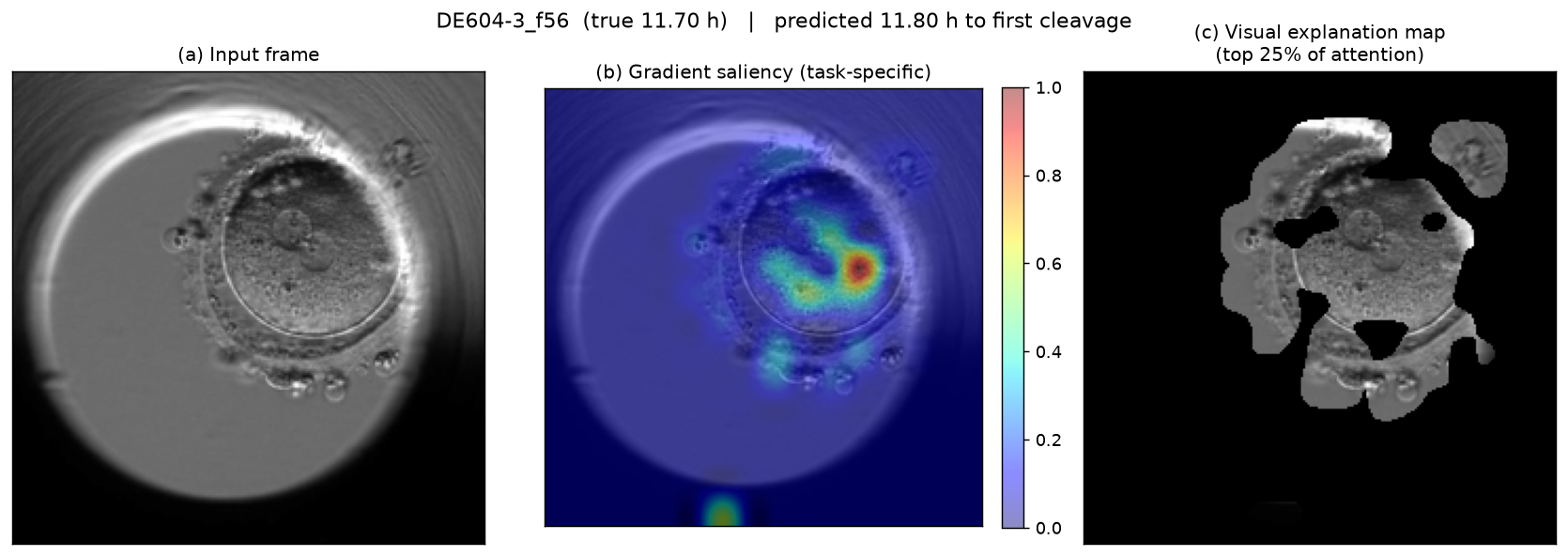
How we know this map is real. Any saliency method can produce a confident, meaningless picture, so all three were scored against occlusion — masking a region and measuring how far the prediction actually moves, which makes no assumptions at all. The gradient map above tracks occlusion at a rank correlation of 0.38. The backbone’s own attention, which is free to compute and is what most published figures show, scored 0.00 against the same yardstick — so it is not shown here, because on this model it explains nothing.